One Clinical Execution Model, Across Cancer Care

Bladder cancer navigation at scale - a case in point

Monitored

8845

Active Patients

Represented

50

Locations

Last 90 days

338 / 568

Interventions / Notes

Recorded

961

Close Events

EXECUTIVE STATEMENT

A large multi-site urology group uses Clinical-i to continuously monitor 8,845 active bladder cancer patients across 20+ locations.

The platform converts fragmented clinical data into prioritized work - gap detection, navigator action, patient engagement and documented closure.

Bladder cancer is the proof case; the execution model is reusable across cancer care.
The story

From invisible work to an auditable operating model

Problem Statment

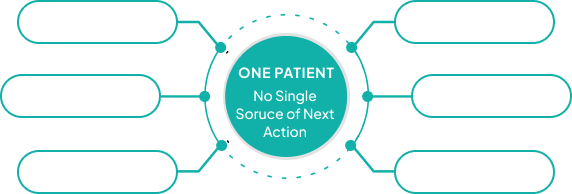
Cancer care relies on linked steps, but the data guiding each one is scattered.
  • Pathology, imaging, orders live in different places.
  • Risk, stage, prior therapy etc changes next steps.
  • Navigators manually determine who needs what.

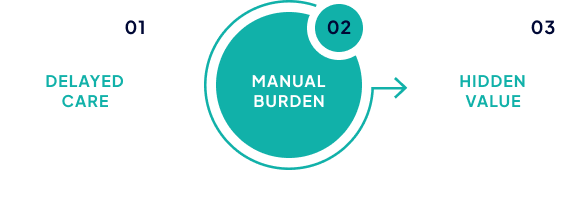
Consequences

The patient gets seen, but the next required action often goes unseen.
  • Surveillance, treatment, testing, become overdue.
  • Navigator effort shifts from intervention to chart hunting.
  • Therapy and trial revenue stays hidden in existing data.

One Continuous Execution Loop

Our Solution

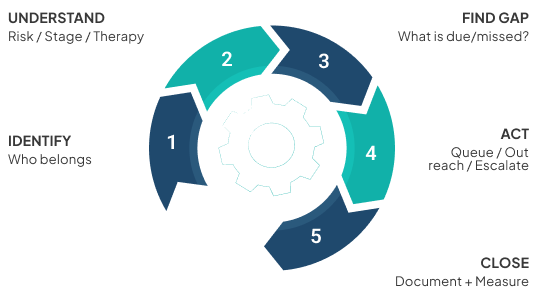
Clinicali turns scattered data into a continuous monitoring, surfacing exceptions that need attention.
  • Identify and stratify each patient.
  • Apply guideline + clinic logic.
  • Surface gaps; engage, escalate, close.
Results + Measurability

Every stage leaves a measurable operational footprint.

71

Surveillance Due

276

BCG Maintenance Open

325

Reminders Open

79

Surveillance Task

Measured as queues -> engagement -> messages -> status change -> closure. Results by location, provider and workflow.

PARALLELS WITH OTHER CANCERS

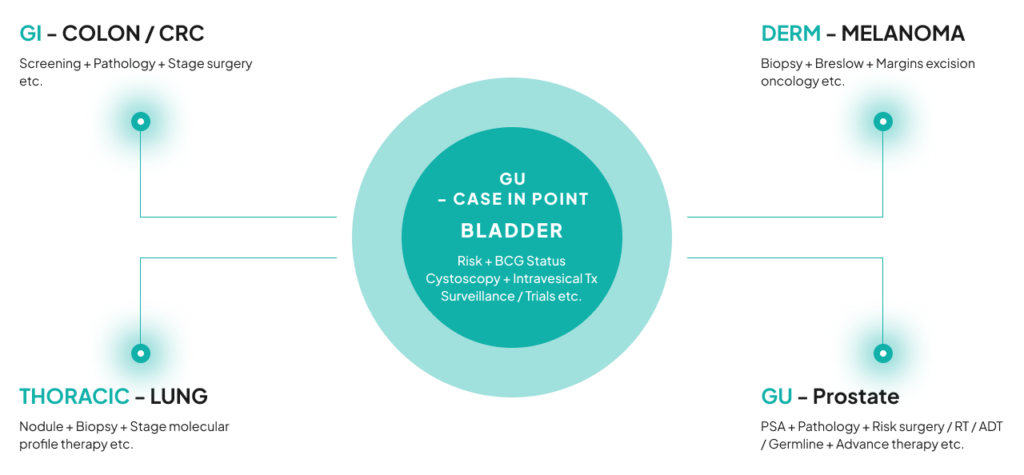
One Clinical Model, Across Cancer Care

The disease changes. The execution model does not.

What Stays Constant

Data ingestion -> Guideline logic -> Gap detection -> Prioritized queue -> Outreach / escalation -> Closure -> Reporting

What changes by condition

ICD/CPT/HCPCS, pathology, staging, risk, therapies, surveillance intervals, testing and trial criteria

Conclusion

Bladder cancer is the case in point. Clinical-i is the reusable execution layer

  • The same architecture can support GU, GI, dermatology Etc.
  • A new disease changes the clinical logic and codes; engine stays the same.
  • One operating model makes complex care visible, prioritized and measurable across sites.

Clinical

Fewer hidden gaps

Guideline-driven prioritization

Operations

Less chart hunting

Scalable navigator workflow

Financial

Makes testing, therapy, trials
and revenue opportunity visible

let's connect

Ready to Close the Loop?

Let’s build a care system where every test, follow-up, and communication is tracked — for better care and stronger risk management.